
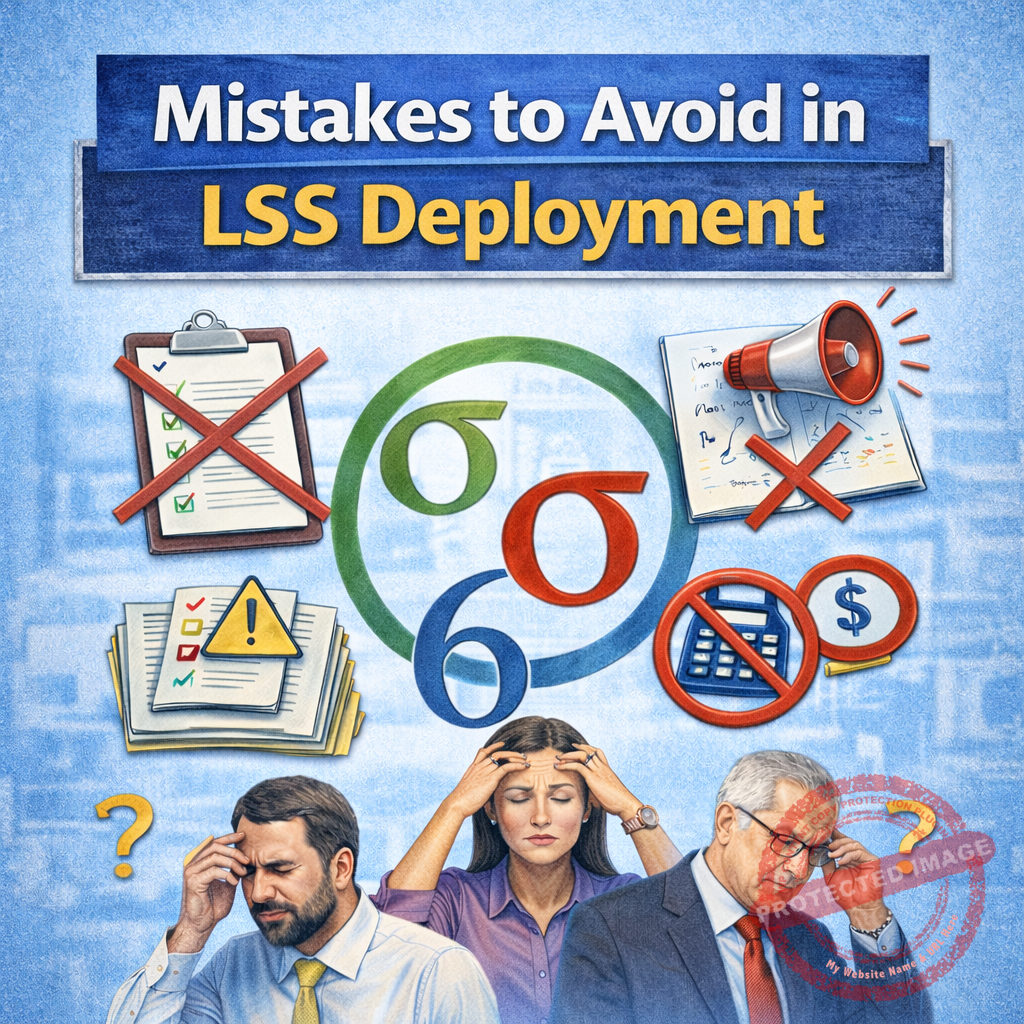
Why Most Lean Six Sigma Programs Fail (Even with Good Intentions)
Over the years, many organizations invest heavily in Lean Six Sigma training, certifications, and tools. Leaders sponsor programs with the right intent. Employees enroll with high motivation. Dashboards look promising in the first few months.
Yet, after a year or two, many deployments silently fade.
The language changes from:
“Lean Six Sigma is transforming us”
to
“We tried Six Sigma once.”
This is not because Lean Six Sigma does not work.
It is because most organizations repeat the same avoidable mistakes.
Lean Six Sigma is not a toolkit.
It is a management system for sustainable performance excellence.
When implemented incorrectly, it becomes paperwork, compliance, or just another short-lived initiative.
In this article, we shall see the most common mistakes in Lean Six Sigma deployments across industries — and more importantly, how you can avoid them if you want real, measurable business impact.
Mistake #1: Treating Lean Six Sigma as a Certification Program, Not a Business Strategy
One of the biggest mistakes is turning Lean Six Sigma into a training factory.
It is often said:
- “How many Green Belts have we certified this quarter?”
- “How many Black Belts can we train this year?”
But rarely:
- “How much business impact did these projects deliver?”
- “Which strategic KPI moved because of Lean Six Sigma?”
When certification becomes the goal, projects become artificial.
People select “safe projects” that can be completed easily for certification — not projects that matter to the business.
What to do instead:
Always insist that certification must be a byproduct of business improvement, not the objective.
Start with business problems. Then use Lean Six Sigma to solve them. Certification will naturally follow.
Mistake #2: Choosing the Wrong Projects (The Silent Killer of Six Sigma Programs)
Most deployments don’t fail in Improve or Control.
They fail before Define — during project selection.
Common project selection mistakes:
- Choosing politically safe projects
- Selecting low-impact problems
- Picking problems where the solution is already known
- Running DMAIC on new processes (should be DFSS)
- Selecting projects without leadership sponsorship
When projects don’t matter to leadership, Six Sigma loses relevance.
What to do instead:
Every Lean Six Sigma project must link to:
- Business strategy
- Customer experience
- Cost of poor quality
- Risk or compliance
- Delivery performance
If your CEO cannot see the value of your project, your deployment is already in trouble.
Mistake #3: Overcomplicating Lean Six Sigma with Jargon and Heavy Templates
Brilliant engineers and frontline employees lose interest in Six Sigma because it is presented as:
- Complex jargon
- Overloaded templates
- Heavy documentation
- Tool-for-every-problem thinking
Six Sigma was created to simplify problem-solving, not complicate it.
When teams feel:
“This is too theoretical”
or
“This is only for statisticians”
…you’ve already lost adoption.
What to do instead:
Learn Six Sigma in business language, not textbook language.
Use:
- Simple visuals
- Real examples
- Practical data
- Minimal documentation
- Only the tools needed for the problem
Lean Six Sigma must feel like common sense — powered by data.
Mistake #4: Not Involving Frontline Teams (Designing Solutions from the Boardroom)
Another fatal mistake is designing solutions without involving the people who actually do the work.
When Lean Six Sigma becomes:
- Management-driven
- Consultant-driven
- Documentation-driven
…frontline teams disengage.
Yet, frontline employees know:
- Where the delays happen
- Why rework occurs
- Which approvals are meaningless
- Which steps are waste
Ignoring them leads to beautiful process maps and useless solutions.
What to do instead:
Make Lean Six Sigma operator-led, not auditor-led.
Involve:
- Customer support agents
- Developers
- Operators
- Technicians
- Process owners
When people co-create solutions, adoption becomes natural.
Mistake #5: Treating DMAIC as a Rigid Checklist Instead of a Thinking Framework
DMAIC is not a ritual.
It is a thinking model.
Yet many deployments treat it as:
- Fill Define template
- Fill Measure template
- Fill Analyze template
- Fill Improve template
- Close project
This kills curiosity and problem-solving.
DMAIC should help teams:
- Think deeply about the problem
- Validate assumptions with data
- Challenge existing beliefs
- Design sustainable controls
What to do instead:
Teach DMAIC as a decision-making framework, not a documentation workflow.
Focus on why each phase exists, not just what to fill.
Mistake #6: Expecting Tools to Fix Culture
Lean Six Sigma tools do not change culture.
Leadership behavior changes culture.
Many leaders expect:
- A few belts
- Some dashboards
- A few projects
…to magically change mindsets.
But culture shifts only when leaders:
- Ask data-driven questions
- Encourage root cause thinking
- Reward problem-solving
- Support experimentation
- Accept learning from failure
What to do instead:
Leaders must role-model Lean Six Sigma thinking.
When leaders ask:
“What does the data say?”
“What is the root cause?”
“What is the process failure, not the people failure?”
…culture begins to change.
Mistake #7: Focusing Only on Cost Savings and Ignoring Customer Value
Lean Six Sigma is often misunderstood as a cost-cutting tool.
When employees hear:
“Six Sigma is here to reduce cost”
They translate it to:
“Six Sigma is here to reduce people.”
This creates fear, resistance, and hidden sabotage.
What to do instead:
Lean Six Sigma is about:
- Improving customer experience
- Reducing frustration
- Making work easier
- Reducing firefighting
- Creating capacity through waste elimination
Cost reduction becomes a result, not the purpose.
Mistake #8: No Governance, No Sustainability
Many deployments start strong but fade because:
- No review cadence
- No leadership governance
- No benefit tracking
- No standardization
- No capability building
Projects close, but benefits don’t sustain.
What to do instead:
Create:
- Monthly project reviews
- Benefit tracking dashboards
- Process ownership
- Control plans
- Knowledge repositories
- Internal coaches
Sustainability is designed — not hoped for.
Mistake #9: Ignoring Change Management
Lean Six Sigma changes:
- How decisions are made
- How problems are discussed
- How performance is reviewed
This is change, and change creates resistance.
Ignoring human psychology leads to:
- Passive resistance
- Compliance without commitment
- Silent failure
What to do instead:
Combine Lean Six Sigma with:
- Communication
- Leadership sponsorship
- Recognition
- Early wins
- Employee storytelling
Change sticks when people feel respected, not instructed.
Mistake #10: Treating Lean Six Sigma as a One-Time Initiative
The final and biggest mistake:
“We ran a Six Sigma program last year.”
Lean Six Sigma is not an event.
It is an operating system for excellence.
When treated as a project or campaign, impact fades.
What to do instead:
Embed Lean Six Sigma into:
- Performance reviews
- Strategy execution
- Operational reviews
- Leadership routines
- Daily management
When Lean Six Sigma becomes how the organization thinks, it stops being “a program” — and starts becoming the way work gets done.
Final Reflection: Lean Six Sigma Is Simple — We Make It Complicated
Lean Six Sigma works across industries, cultures, and scales.
It has survived decades because it solves real business problems.
When it fails, it is not because of the methodology.
It fails because of how we deploy it.
If you avoid these common mistakes:
- Your projects will matter
- Your teams will engage
- Your leaders will trust the method
- Your results will sustain
Lean Six Sigma will stop being “another initiative”
and start becoming your organization’s competitive advantage.

